Ultrasonic Extraction Equipment: Cavitation, Solvent Choice and Scale-Up
2026-10-21 11:46:53Start with the extraction question, not the ultrasound wattage
A supplier can quote ultrasonic power, a vessel volume and a temperature range, yet those values do not predict the composition of an extract. A botanical material can produce different yields depending on plant part, grinding history, moisture, solvent, solid-to-liquid ratio, mixing, temperature and the separation step that follows. Ultrasound is one element of that process, rather than a substitute for an extraction method.
At OLLITAL, we recommend evaluating ultrasonic extraction equipment against three defined outputs: the amount of the desired material recovered, its measured quality and the resources required per accepted batch. Those outputs provide a more useful basis for comparing equipment than a promise that ultrasound always makes extraction faster.
1 | What cavitation can change and what it cannot
In an ultrasonic liquid field, alternating acoustic pressure can generate and collapse cavitation bubbles under suitable conditions. Those events produce localized hydrodynamic effects, which can improve solvent penetration, disrupt some plant tissue structures and reduce mass-transfer resistance. They are not uniform throughout a tank. Bubble behavior changes with dissolved gas, solvent properties, static pressure, temperature, acoustic frequency and local geometry.
More indicated electrical power does not necessarily mean more useful energy reaches every part of the slurry. The effective field depends on how sound couples into the vessel, how the material moves past the active region, the configuration of transducers or probes, and losses in the system. For a comparison trial, record the actual equipment configuration and operating method. Do not treat nominal watts per liter as a universally transferable process recipe.
Cavitation is also not a guarantee of beneficial results. Some compounds may degrade through oxidation or localized process stress, and sonication can promote unwanted emulsions or create fine solids that complicate filtration. The target assay and downstream separation therefore belong in the test plan from the outset.
2 | Solvent selection begins with chemistry and safe equipment scope
Solvent choice affects what dissolves, what remains in the solid phase and what impurities accompany the target. Water, ethanol-water mixtures and other solvents can exhibit very different selectivity. A solvent that gives high crude mass may provide a lower concentration of the compound of interest. Water content, pH, ionic strength where relevant and solvent-to-solid ratio all require deliberate selection.
For botanical screening, characterize the feedstock and define the intended extract. Record species or material identity, lot, dry matter, particle-size range, storage conditions and the analytical marker. Then compare a small, controlled set of candidate solvent conditions with consistent residence time and sampling. Solvent choice should also be evaluated for downstream separation and the intended end use, rather than chosen only by extraction speed.
Flammable solvents require a separate safety review. A product page describing an explosion-proof option does not prove that every installed motor, switch, transducer, pump or auxiliary instrument is certified for the buyer's hazardous area. Confirm the delivered electrical specification, zoning or area classification, earthing, ventilation, temperature limits, materials and relevant compliance documentation before approving the configuration.
3 | Prepare the solid phase for repeatable results
Particle size affects wetting, diffusion distance, apparent extraction rate and the tendency for fine particles to pass into the filtrate. Aggressive milling can improve exposed surface area while increasing fines, agglomeration or oxidation. A reproducible protocol specifies the grinding method, size distribution or sieve cut, pre-soak conditions where applicable, solid loading and the feed moisture used to report yield.
The material-to-solvent ratio should be stated on a clearly defined wet or dry feed basis. For example, “1:10” is ambiguous unless the units are supplied and it is clear whether this is kilograms of dry material per liters of solvent or another measure. Adequate mixing and contact are equally important: settling plant solids can shield part of the batch from useful liquid circulation even when the surface looks active.
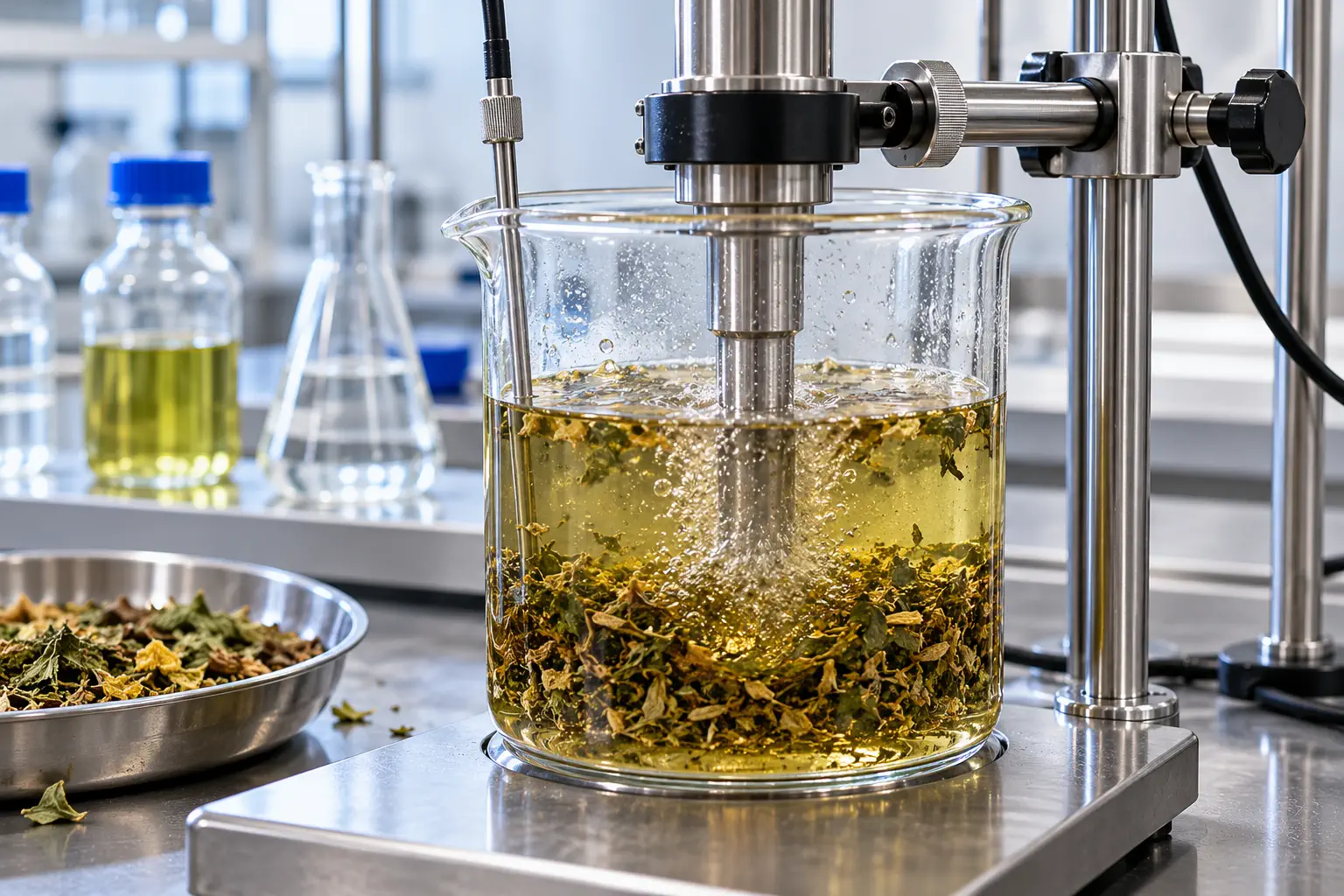
Figure 1 | Editorial close-up of a laboratory sonication trial with botanical solids. A probe setup is an illustration of a test method, not the geometry of the OLLITAL extraction tanks.
4 | Keep temperature control separate from the sonic setting
Ultrasonic power dissipated into the liquid contributes heat, which may raise bulk temperature even without an active heater. Vessel walls, ambient conditions, circulation and solvent evaporation also affect the actual temperature profile. A controller setpoint by itself does not establish the temperature experienced by every part of a stirred or recirculating slurry.
For heat-sensitive extracts, record the liquid temperature at a relevant location during sonication and compare it with a control trial operated at a similar measured temperature without ultrasound. This can separate some thermal effects from the additional influence of sonication. Where the process uses cooling or a jacket, monitor the heat removal capability across the run rather than assuming that a nominal chiller temperature protects the product.
Longer residence time can improve recovery up to an approach to equilibrium, yet it can also promote changes in color, aroma, impurity profile or active-marker concentration. Choose the endpoint from a time-course study with quality measurements, not simply from the duration of visible turbulence.
5 | A practical trial matrix before buying a larger system
Use a consistent feed lot and validated analytical method. A small matrix can screen solvent composition and solids loading while holding temperature, vessel geometry and sampling basis as constant as practicable. Only expand to sonication time, power setting or mixing rate once the main chemical conditions are understood. If experiments are run in different equipment, note the difference instead of treating equal display settings as equal energy delivered.
| Test element | Record or compare | Why it matters |
|---|---|---|
| Feed identity | Lot, material part, moisture and particle range | Avoids assigning feed variability to the equipment |
| Solvent system | Composition, concentration, total volume, batch losses | Defines selectivity and liquid-to-solid ratio |
| Ultrasonic treatment | Hardware configuration, setpoint, duty pattern, run time | Provides a reproducible operating description |
| Thermal history | Measured liquid temperature over time, cooling conditions | Separates heat effects from other process effects |
| Output quality | Target-marker assay, impurity profile, color or functional property | Prevents crude mass from substituting for product quality |
| Downstream losses | Filtrate, wet cake, rinse, recovered solvent and residues | Identifies whether separation masks extraction performance |
Independent repeat batches or appropriately designed replicates help estimate real process variability. A single impressive result does not establish an expected operating range. Include a non-ultrasonic control when trying to quantify the added value of acoustic treatment, while keeping feed lot, solvent conditions, thermal exposure and downstream recovery method as comparable as possible.
6 | Report both extraction yield and selective recovery
A reliable report states what was measured and on which basis. Crude extract yield is often defined as recovered extract solids divided by the dry mass of starting feed, but it can include co-extracted non-target material. Target recovery uses the measured quantity of a specified target component in the recovered stream relative to its measured or estimated amount in the feed. The two percentages answer different questions and should not be interchanged.
Measure residual solvent or water when comparing concentrated outputs; otherwise two samples with different moisture content may appear to have different yields. Keep filtration and concentration losses separate where possible. An improvement in dissolved target leaving the extractor can disappear later because of solids handling, adsorption on filters, incomplete transfer or heat damage in the concentrator.
A minimal material balance includes dry feed charged, solvent added, filtrate recovered, retained solids, cleaning or rinse fractions, concentrated output and recovered solvent. Where full closure is not feasible, explicitly list unmeasured hold-up rather than attributing the missing mass to “ultrasound efficiency.”
7 | Moving from a beaker to a recirculating pilot system
Process scale-up changes acoustic coverage, circulation time, mixing energy, heat removal and the distance between material and the active treatment region. Copying the same watts per liter or the same sonication duration from a beaker is not a defensible guarantee of equivalent results in a larger tank. In a recirculating process, the volume flow rate, number of passes, hold-up and local residence-time distribution must also be considered.
A good pilot trial defines the duty in process terms: the amount of dry feed and solvent, target assay, throughput or campaign size, acceptable temperature excursion and a measurable quality limit. Compare concentration curves and energy consumed per unit of accepted output, rather than making throughput the only success metric.
A flow diagram should identify feeding, pretreatment, liquid circulation, ultrasound contact region, filtration, concentration, condenser, solvent collection and cleaning access. If the application is viscous, solids-rich or foaming, ask for a practical assessment of pumpability and gas management. Acoustic power on the nameplate cannot resolve a blocked filter or poorly suspended solids.
8 | Extraction and concentration are separate engineering steps
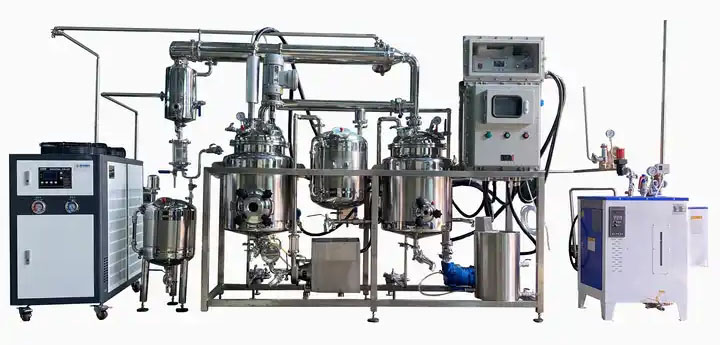
Ultrasound may assist the initial release of material, but vacuum concentration and solvent recovery present different challenges. The evaporator must remove solvent while controlling liquid temperature, foaming and fouling; the condenser must handle the expected vapor load; and the recovered liquid must meet any applicable handling requirements. Equipment described as multifunctional may integrate these stages, but the final delivered piping, pump and condenser scope should be checked line by line.
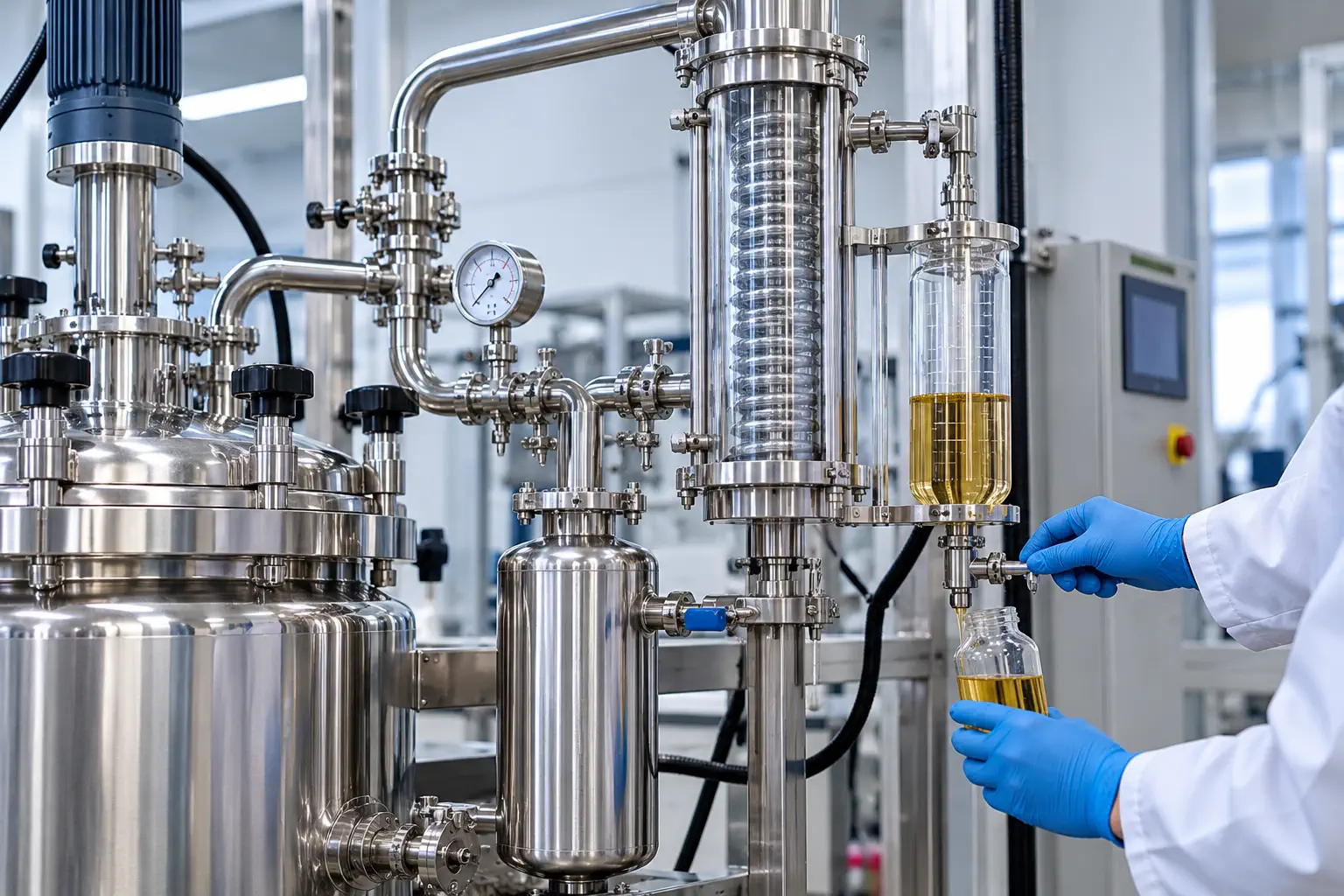
Figure 2 | Editorial visualization of an extract sampling and condensation stage. The image does not establish the included fittings or solvent-handling certification of an OLLITAL product.
For a solvent recovery comparison, calculate the recovered solvent mass or volume using a defined basis and suitable composition checks. Distinguish condensed recovered solvent from evaporative losses and liquid still held in tanks or wet solids. Where the product is heat-sensitive or volatile, monitor the assay before and after concentration. A high initial extraction yield is not useful if the downstream step changes the desired product.
9 | Questions to send with an equipment inquiry
| Buyer question | Engineering clarification to request |
|---|---|
| Which materials and solvents will run? | Wetted metallurgy, gaskets, seal compatibility and the approved cleaning procedure |
| What is the real operating volume? | Minimum/maximum working load, solids fraction, mixing approach and fill limits |
| How is ultrasound delivered? | Source and contact arrangement, controls, duty cycle and power reporting |
| How is the batch kept within temperature limits? | Jacket or cooler capacity, temperature-sensor position and alarm handling |
| Which solvent-recovery components are included? | Actual tank, pump, condenser, vacuum and receiving arrangement |
| How will acceptance be demonstrated? | Defined feed trial, target assay, repeatability, batch time and quality criteria |
The OLLITAL website lists a Y-TQ-C30L multifunction extraction tank and a TD-series extraction/concentration product family. The published descriptions support discussing extraction, concentration and recovery arrangements, but they do not establish a universal extraction improvement for all plants or an automatically included option on every order. Confirm current drawings, heating/cooling details, materials, controls and any solvent-specific safety requirements in the quotation and approved technical documents.
Build the purchase decision around a measurable product
Ultrasound is most useful when it helps meet a specific mass-transfer, time or quality objective under conditions that can be reproduced. The strongest investment case combines an analytically defined target with a controlled feed, safe solvent choice, adequate circulation and a downstream process that preserves the benefit of extraction. A credible supplier comparison specifies the acceptance method as carefully as the equipment.
At OLLITAL, we suggest sharing a short process brief and representative samples before finalizing the ultrasonic extraction system. Include the feed identity, dry material input per batch, planned solvent, acceptable product temperature, target output concentration and any filtration challenges. Those details make it possible to discuss a realistic configuration and meaningful trials.
Explore the Y-TQ-C30L ultrasonic extraction equipment and the TD-series extraction and concentration systems for published product context. Final configuration and available options require quotation confirmation.
Considering ultrasonic extraction for a plant-based product? Send your feed and process requirements to Contact OLLITAL for an equipment discussion.