Seed Train Design for Microbial Fermentation: From Shake Flask to Glass and Stainless Steel Bioreact
2026-10-14 09:01:15MICROBIAL FERMENTATION / INOCULUM DEVELOPMENT
From Shake Flask to Glass Bioreactor and Stainless Steel Seed Vessel
The stage before production that determines what production can achieve
A fermentation batch can be equipped with a capable controller, properly calibrated sensors and a well-designed feed program, yet still lose time because its inoculum is not ready. The origin of a slow or inconsistent fermentation may be several steps earlier: an aging shake-flask culture, an unrepresentative sampling result, an extended transfer hold, or a change in physiology between seed stages. A seed train is therefore not just a chain of containers. It is a controlled series of decisions about culture quality, timing, transfer and traceability.
This field guide focuses on microbial fermentation for research, process development and pilot operation. It covers the transition from shake flask to a laboratory glass bioreactor and, when appropriate, to a stainless steel seed vessel. It explains what teams should validate before each transfer, what the equipment needs to support, and how to record an inoculum history that remains meaningful when batch size changes.
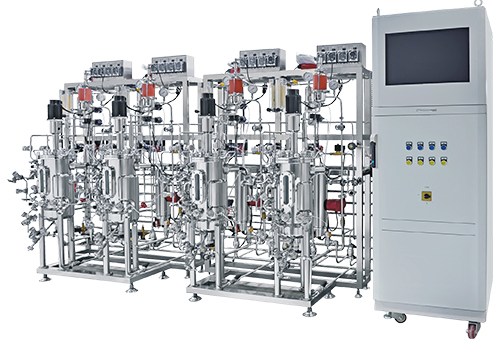
OLLITAL lists laboratory glass fermentation systems such as the OLT-100-M1 glass bioreactor and stainless platforms such as the OLT-500-C1 stainless steel fermentation system. These public product pages provide legitimate equipment starting points, but they do not mean every installation has the same seed-transfer piping, sterilization arrangement or online analytical package.
Stage 1 | Design the inoculum backward from the receiving vessel
It is tempting to begin with whatever shake flask volume is already on the shelf. A more defensible approach begins at the receiving fermenter. Specify the expected process start: working volume, medium composition, organism or production strain, desired initial biomass or inoculation ratio, oxygen requirement, and any known sensitivity to transfer or medium changes. Then determine what the seed stage must deliver to establish that starting state reproducibly.
Nominal vessel capacity is not a practical inoculation volume. A “10 L” label may describe an equipment family while the working volume and usable minimum differ by configuration. For example, OLLITAL publishes separate total, working and minimum working volumes for its glass and stainless vessels. Buyers should distinguish those values when comparing seed train stages, instead of multiplying nominal liters by an assumed ratio.
Work backward through the anticipated stage transitions. Decide which transitions are justified by biological performance and vessel operating limits, not by tidy geometric ratios. A small flask may be adequate for analytical screening while a glass bioreactor may be needed for pH and dissolved-oxygen observation. A stainless seed vessel can then test sterility boundary, gas delivery, mechanical mixing and utility integration closer to the next process stage.
What must remain comparable between stages?
The goal is physiological continuity, not identical setpoints. A culture adapted to one carbon source, nitrogen regime or dissolved-oxygen history can respond differently when introduced into another medium. Record the intended growth phase, adaptation period, biomass measurement method and anticipated oxygen demand. If process parameters differ substantially across stages, evaluate those changes explicitly rather than assuming vessel scale alone explains the outcome.
Stage 2 | Decide whether the culture is actually ready
Elapsed time is an easy scheduling variable, but it is not a stand-alone release criterion. A seed culture should be evaluated against predefined, organism-appropriate indicators. Depending on the process, useful observations may include growth trend, viable count or viability assay, optical density or biomass estimate, microscopic morphology, medium pH, residual substrate and evidence of contamination. The applicable test panel, acceptance ranges and frequency belong to the validated process or development plan, not to a generic article.
A clean-looking flask does not establish sterility. Nor does a sharp increase in turbidity necessarily indicate a healthy inoculum: dead cells, aggregates or non-target organisms can distort bulk measurements. Use orthogonal methods when the process warrants them and make each result traceable to a sample, time and specific seed stage.
A release decision that combines biology and operations
A robust decision checks three layers. First, biological suitability: is the intended organism growing and behaving as expected? Second, contamination status: are monitoring results consistent with the approved release criteria? Third, transfer readiness: is the receiving equipment prepared, have relevant connections been qualified and is the seed culture still within an acceptable holding window? A “pass” in only one layer is insufficient.
| Release dimension | Evidence to review | Reason to pause or investigate |
|---|---|---|
| Culture state | Time-aligned growth, viability or suitable morphology data | Unexpected lag, decline, abnormal morphology or inconsistent analytical results |
| Identity / purity | Strain identity and contamination checks as required | Unexpected organisms, unresolved contamination signal or sample traceability gap |
| Process compatibility | Medium, working volume, gas regime and receiving-stage conditions | Unexplained change in medium or oxygen availability |
| Transfer readiness | Equipment status, sterile boundary and permitted hold time | Unqualified connection, uncontrolled delay or ambiguous preparation record |
Stage 3 | Move from shake flask to a laboratory glass bioreactor
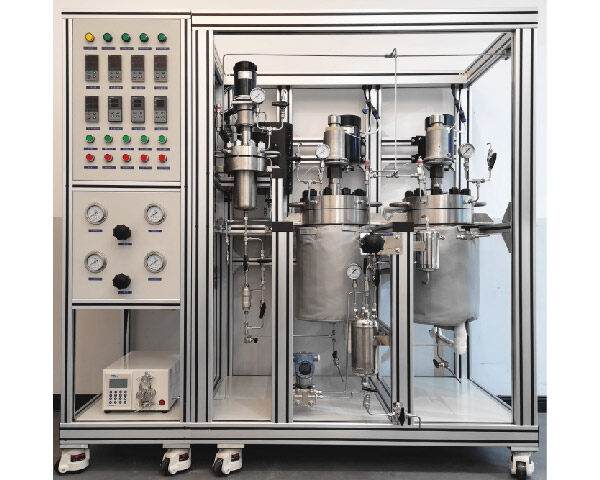
A glass fermenter adds process visibility and controls that a flask does not provide. In the OLLITAL laboratory glass bioreactor, the published configuration includes temperature, pH, dissolved oxygen, agitation and aeration control, with peristaltic pumps and configurable functions. These features can help development teams distinguish biological lag from environmental limitations after inoculation. Exact pump allocation, sensor package and control logic still need to be confirmed for the ordered variant.
Before introducing the seed, establish that the receiving vessel and the intended medium have passed the project’s preparation checks. Small glass systems commonly use separately sterilizable glass vessel components; sensitive electronic and motorized control assemblies are not simply placed in an autoclave. The sterilization and reconnection sequence must follow the specific system design, validated procedure and component compatibility. After assembly, a suitable sterile-boundary check should be completed before inoculation.
The first hours of culture transfer are particularly informative. Compare the seed’s documented state with actual receiving-vessel observations: baseline pH, dissolved oxygen, temperature, agitation, aeration and any expected growth response. A change in DO alone is not proof that inoculation succeeded or failed, because it reflects both oxygen supply and consumption. Use a combination of process data and culture analytics.
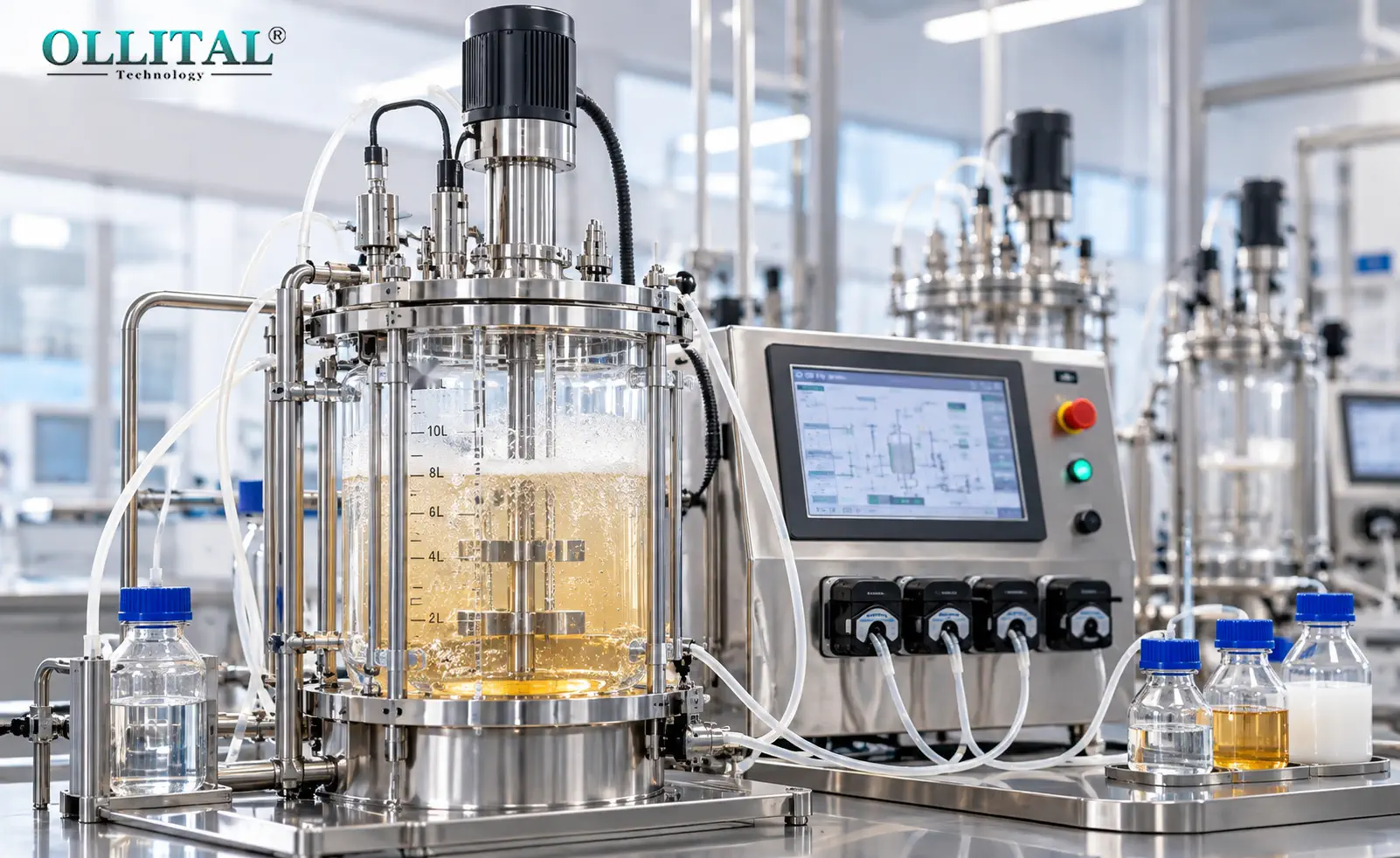
Figure 1. Glass bioreactor, feed connections and controller in a laboratory setting. Editorial illustration for the receiving-stage discussion; actual OLLITAL configurations should be checked against product photos and project specifications.
Stage 4 | Protect the sterile boundary during transfer
When a culture leaves one vessel, its microbiological state must be protected all the way to the receiving vessel. The actual route may involve a verified sterile connector, a presterilized closed transfer set or suitably designed fixed piping, depending on configuration. No single transfer arrangement should be presumed from a catalog photograph. The critical idea is to define the sterile boundary across the donor outlet, transfer path and receiving inlet, and to assign responsibility for every interface.
The receiving vessel should not be treated as sterile merely because the tank itself was cleaned or sterilized. Valves, gaskets, sample ports, gas filters, pressure boundaries, tubing and the connection at the moment of transfer are all part of the system. A transfer-line dead leg or an unverified hose change can undermine otherwise careful vessel preparation. Where appropriate, integrity or sterility checks should be defined and documented before starting the next batch.
Sterilization also changes with scale. A laboratory glass vessel may rely on off-line autoclaving of eligible components. Stainless seed systems often use a configured sterilization-in-place (SIP) method, which involves steam, condensate management, valve sequencing and utility requirements. The OLLITAL stainless steel fermentation system publishes SIP among its vessel features; the actual commissioned procedure and installed valves should be checked against the specific project drawings.
Treat transfer as a controlled operation with a clear pretransfer decision, trained personnel, a designated transfer path, defined stop conditions and recording of any unexpected delay. Avoid assuming that a simple open pour or improvised fitting is equivalent to a qualified aseptic transfer.
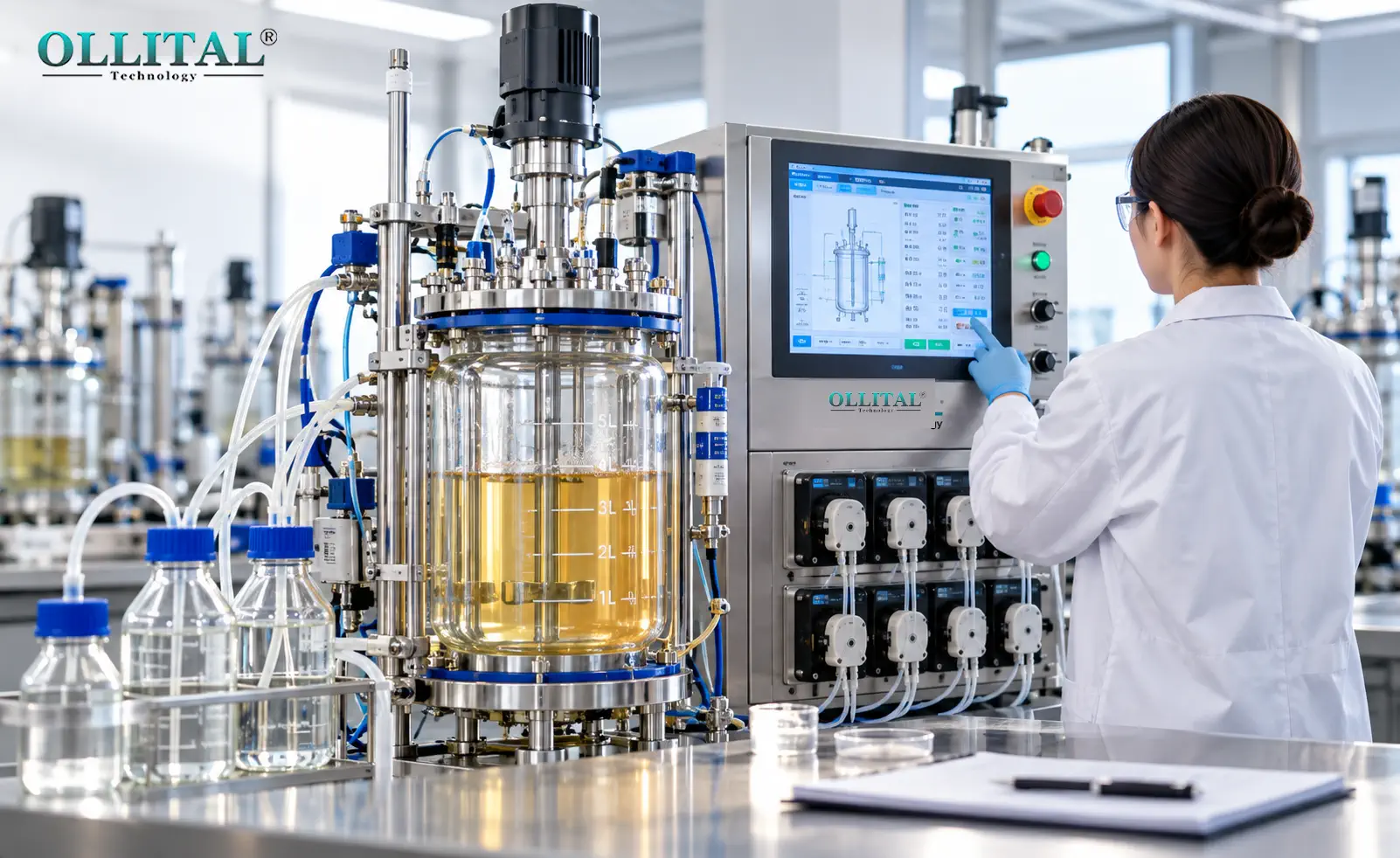
Figure 2. Operator reviewing a glass bioreactor control interface. Editorial illustration of post-transfer monitoring; equipment geometry, controller layout and process values are not verified OLLITAL specifications.
Stage 5 | Introduce a stainless steel seed vessel for process realism
A stainless seed vessel is most useful when it answers a real engineering question: can the culture enter the next scale through a workable, hygienic and reproducible operating route? At this point, more attention may be needed for gas distribution, oxygen demand, heat removal, transfer timing, fluid residence, sampling access and the handling of utilities. The purpose is not to recreate the lab vessel at larger dimensions; it is to preserve the biological outcome while controlling new scale-related risks.
For microbial cultures with high oxygen demand, seed quality includes the ability to recover from transfer and resume expected growth under the receiving vessel’s oxygen-transfer conditions. Pump speed, aeration setpoints and DO curves should not be copied without considering vessel geometry and dynamic demand. If there is a discrepancy between laboratory and stainless-stage behavior, examine the inoculum history together with mixing, gas, medium and sensor effects.
The OLLITAL stainless product family provides published options for mechanical drive, process measurement and feed or antifoam control, but customization and optional functions mean that a proposed seed-train architecture must be confirmed from the actual quotation and engineering configuration. A seed vessel is defined by its process role, not solely by its capacity label.
The handover record: one culture history, not disconnected spreadsheets
Seed train performance can only be compared when data from different stages are connected. The transfer record should include the source culture identification, inoculum volume or mass, measured or estimated biomass, growth phase, analytical release status, receiving vessel identification, hold time, transfer start and finish times, receiving conditions and any deviations. The point is to make the initial state of the downstream batch explainable.
A well-structured handover distinguishes what the process team planned from what actually happened. If a pump setting changed but the delivered volume did not match, that difference matters. If the transfer was delayed or the inoculum cooled or warmed unexpectedly, the next-stage lag may be biological rather than a defect in the receiving bioreactor. These are the kinds of facts that help process development move from a single successful batch to reproducibility.
| Handover item | Minimum practical record |
|---|---|
| Culture identity | Source vessel, batch ID, strain or organism, inoculum preparation date |
| Seed quality | Growth/viability method, release decision, time of last sample |
| Transfer | Approved route, start and finish time, actual delivered quantity, handling exceptions |
| Receiving state | Vessel ID, medium, working volume, baseline pH, DO, temperature and gas conditions |
| Deviation history | Unusual hold, transfer interruption, contamination alert and resolution |
Failure patterns that look like “bad seed” but are not always biological
Unexpectedly long lag after transfer
An extended lag may reflect late-stage inoculum, medium mismatch, shear or handling stress, an unrecognized transfer delay, oxygen limitation, or contamination. Start with evidence rather than assigning a single explanation. Compare pretransfer culture measurements with what happened immediately in the receiving vessel.
Large run-to-run variation with the same recipe
A recipe alone does not guarantee comparable seed physiology. Differences in flask fill, oxygenation, culture age, inoculation timing, sampling or hold period can affect downstream behavior. Record those variables alongside the receiving vessel operating data to identify what actually changed.
Growth appears normal but later yield is inconsistent
The inoculum may have started the batch with a different metabolic state even if biomass looks similar. Revisit substrate and oxygen history, culture morphology and transition timing. Product formation may be more sensitive to inoculum history than the initial bulk biomass measurement suggests.
An apparent contamination event after inoculation
Do not infer the source from one alarm or appearance change. Follow the organization’s approved contamination investigation and containment procedure, preserve samples and traceability, and review the qualified sterile boundary: donor preparation, transfer path, receiving equipment and sample-handling events.
Questions to settle before specifying the equipment
For a new project, the engineering conversation is more productive when the buyer supplies both biological and mechanical context: organism and intended medium; starting and target working volumes; seed stages envisaged; inoculation and hold-time assumptions; preferred sterilization approach; aseptic connection strategy; aeration and agitation needs; planned sampling tests; available utilities; and the target next vessel. Include what is unknown. An unresolved requirement is safer to state explicitly than to conceal inside a generic equipment request.
A laboratory development plan may start from the OLT-100-M1 glass fermenter, then discuss stainless configurations on the OLT-500-C1 product page. These are site-supported starting points, not a promise that all fittings or transfer kits are preinstalled. A manufacturer review is still needed before final selection.
Closing perspective: inoculum quality is a process input
The most useful seed train is not necessarily the one with the most stages or the largest intermediate vessel. It is the one that produces a defined, traceable and transferable culture state with manageable contamination risk. Start with the biological release decision, define a trustworthy sterile transfer route, and verify the receiving vessel’s process conditions. Those steps turn inoculation into a controlled part of fermentation engineering rather than an assumption at the beginning of each batch.
At OLLITAL, we recommend beginning with your organism, actual stage volumes, inoculum-release approach, transfer boundaries and utilities. If you are moving from shake-flask experiments into glass or stainless systems, review our Bioreactor & Fermentation equipment and Contact OLLITAL with the basic seed-train requirements. That gives the engineering team a practical foundation for discussing a configuration that supports the process you intend to run.