Fed-Batch Fermentation Feeding Strategy: Carbon Feed, DO Trends and Foam Control in Bioreactors
2026-10-14 09:15:52FED-BATCH FERMENTATION
PROCESS DEVELOPMENT | FERMENTATION CONTROL | SCALE TRANSFER
Fed-batch fermentation is often described as a simple operation: start with a batch culture, then add concentrated substrate as the cells grow. In practice, the challenge is not adding liquid. It is keeping substrate availability, oxygen demand, pH correction, heat release and foam behavior in a workable balance while the culture changes from hour to hour. A feed program that looks smooth on a pump display can still create local substrate peaks, oxygen stress or repeated antifoam additions inside the vessel.
This guide examines how process teams can build, read and revise a feeding strategy in a laboratory bioreactor or fermentation tank. The aim is not to publish a universal recipe or make unsupported claims about a particular OLLITAL model. Instead, it shows which observations matter, how different feeding approaches behave, and what process information should travel with the equipment inquiry.
The operating question: how much can the culture use right now?
A feed pump meters a solution into the vessel. It does not measure how quickly the organism is consuming that solution. During fed-batch operation, those two rates must be considered separately. When supply outpaces uptake, substrate may accumulate. Depending on the organism and medium, the result can be overflow metabolism, unwanted by-products, osmotic stress, higher oxygen demand or a change in morphology. Conversely, feeding below the actual demand can limit productivity and change the intended physiological state.
That is why feed rate is an output of process development rather than a number that can be selected solely from fermenter capacity. It depends on working volume, medium composition, substrate concentration, biomass, target physiology, oxygen transfer and process stage. A nutrient pump with excellent repeatability cannot compensate for an incomplete metabolic and mass-transfer strategy.
The first useful distinction is between three flows: the nominal pump setting, the actual mass or volume delivered, and the biologically useful substrate supplied. These can differ because tubing ages, viscosity changes, pump calibration drifts, vessel headspace changes, and substrate concentration may not match the preparation record.
Start from process limits, not a preset curve
Before choosing a profile, process teams should define at least the intended organism and growth phase, the desired carbon limitation or excess condition, the measured working volume, the feed concentration, the known oxygen-transfer capacity, the expected culture viscosity, and how deviations will be handled. Do not assume a DO setpoint by itself defines a safe feed rate. The same DO percentage can occur under very different aeration, mixing, pressure and biomass conditions.
Three feeding approaches and what each one can and cannot do
1. Constant-rate feeding: useful for a narrow, known duty
A fixed flow is easy to commission, inspect and document. It can work when biomass and uptake conditions remain within a validated range. Its weakness is that the feed does not automatically account for changing biomass, oxygen transfer or process yield. A constant setting that is modest early in a run may become limiting later, while one sized for later demand may overload the culture early.
2. Time-profiled feeding: a hypothesis written as a schedule
Linear, stepwise or exponential feed profiles are common ways to express a process-development model. They can be valuable when a team knows enough about the organism and the planned growth trajectory. But the profile is still a hypothesis. An exponential schedule should not be treated as proof of exponential biomass growth. The operational record must show whether the actual culture followed the assumption.
3. Feedback-assisted feeding: useful, but easy to misread
Feedback approaches may use DO trends, exhaust-gas signals, biomass estimates, residual-substrate measurements or other validated indicators. They require safeguards against acting on probe noise, mixing transients and control-loop interaction. For example, a sudden DO drop immediately after a feed step may reflect increased respiration, temporarily poorer transfer, a sensor disturbance or multiple mechanisms together. The sensible response is to examine the whole state, not mechanically increase or stop feeding based on one plot.
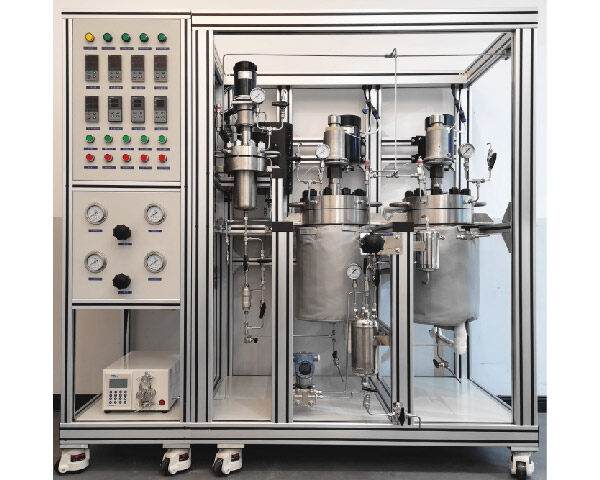
Where supported by the configured hardware and controller, an operator may coordinate feeding control with DO, agitation and pH measurements. The OLLITAL customizable glassware bioreactor page describes feed control associated with DO and pH parameters, but that published feature list must be confirmed for the particular ordered configuration. It should not be generalized to every OLLITAL fermenter.
Why DO changes after a feed step
Dissolved oxygen reflects a balance: oxygen enters the liquid via gas-liquid transfer and leaves it through microbial or cellular consumption. Adding carbon or another limiting nutrient can increase respiration, so a transient DO decline after feeding is plausible. The size, delay and recovery of that response depend on the cells, medium, mixing, aeration, probe location, controller cascade and operating pressure.
If agitation and airflow are already near their practical or validated limits, adding more substrate may only increase oxygen demand without increasing available oxygen supply. In some processes, oxygen limitation changes by-product formation or yields. However, the same trace might also result from a sensor calibration issue, foam affecting gas exchange, an unexpected temperature change or a process upset. A responsible article must not turn the simplified relation “feed up, DO down” into a universal law.
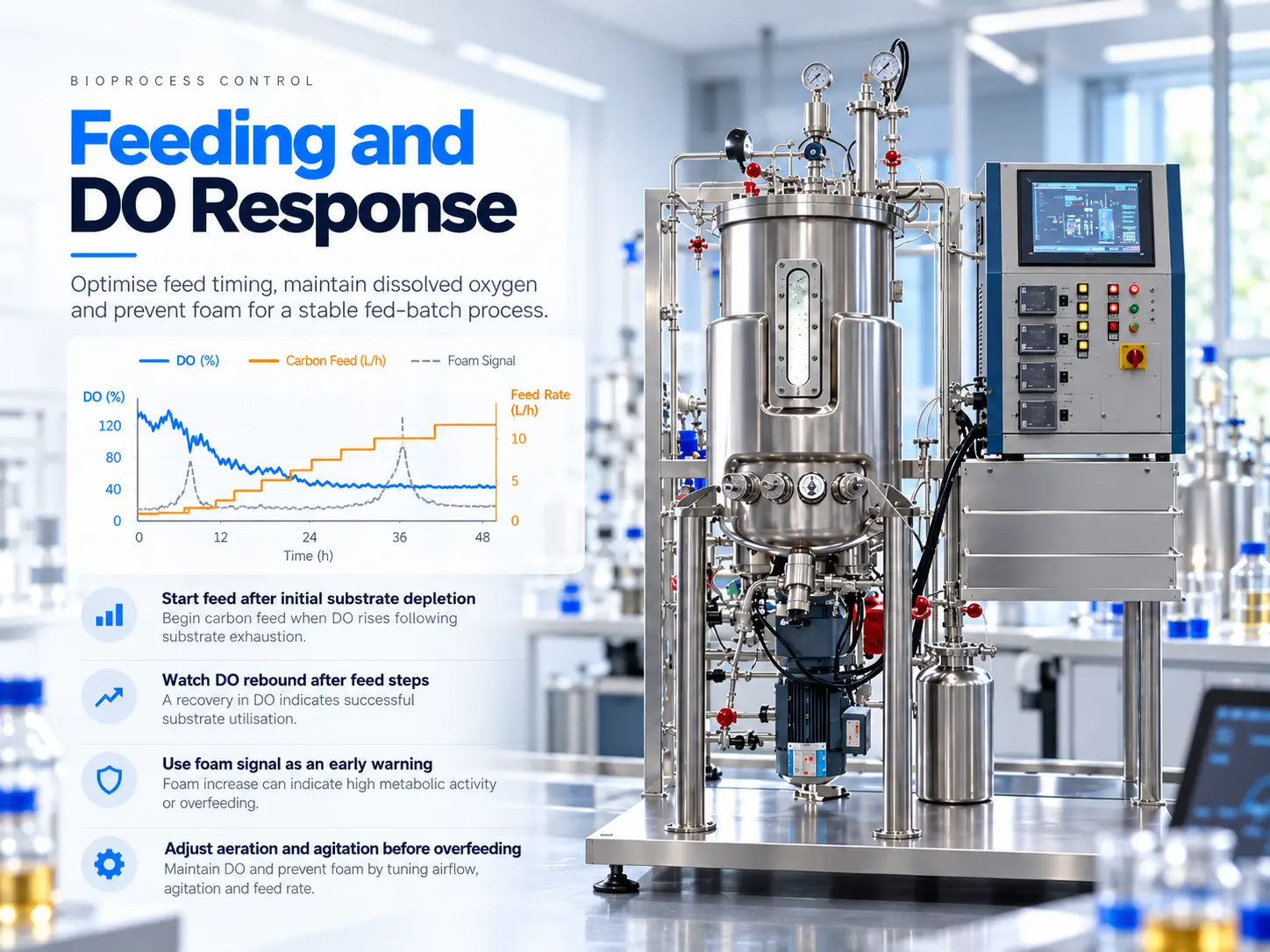
Figure 1. Illustrative process-response relationships only; curves are conceptual, not measured OLLITAL batch data. Verify the DO signal against feed delivery, aeration, agitation and process records.
Read the sequence, not one number
At each planned feed transition, review what changed first. Was the feed pump command issued? Did actual delivered volume or weight agree? Did DO decline before or after the feed change? Did airflow or agitation rise because of an active controller cascade? Was there a pH correction pulse or antifoam addition? Were the exhaust conditions stable? A time-aligned record is more valuable than a single end-of-batch graph.
A comparison of two batches only makes sense if the team records the differences in inoculation, substrate concentration, broth volume, gas configuration, impeller arrangement and sensor performance. “Same feed profile” is not the same as “same fermentation conditions.”
Foam control is part of the feeding strategy
Foam is not only a housekeeping problem. In a gas-aerated process it is affected by medium composition, cellular products, sparging, mechanical agitation and changes in liquid volume. Feeding concentrated carbon or other nutrients may change surface-active compounds or gas evolution. Inadequate headspace or poor exhaust-side design can turn a manageable foam event into a carryover risk.
Antifoam dosing can suppress foam, but excessive additions may alter mass transfer, sensor behavior and downstream separation. That creates a trade-off: solving a foam event with frequent antifoam pulses can obscure an underlying gas or recipe issue. An appropriate strategy distinguishes foam detection, permitted antifoam response, mechanical foam breaking where configured, and the process reason the foam appeared.
For example, the OLLITAL laboratory glass fermenter page lists defoaming detection and process control functions. That is evidence that antifoam control belongs in the configuration discussion; it does not establish an identical foam probe, pump count or antifoam program across every product family.
Do not separate foam decisions from oxygen transfer
Reducing gas flow might decrease visible foam but also reduce oxygen supply. Increasing agitation can improve dispersion but can also increase foam formation and shear. A foam-control strategy therefore needs a review of aeration, gas quality, agitation, working volume, medium and exhaust handling together. Operators should stay within a validated operating envelope and follow approved deviation procedures rather than improvising potentially unsafe changes.
The fermentation feeding run sheet: what to capture
A robust fed-batch record is a synchronized story of actions and responses. At minimum, document feed-solution identity and concentration, calibrated pump channel, feed start and stop times, rate schedule, delivered amount, vessel working volume, DO, pH, agitation, airflow, temperature, foam events, antifoam dosing and major operator interventions. When available and relevant, include off-gas and substrate measurements.
The following compact run-sheet matrix can be reused for process development. It is deliberately a record framework, not a specification for one OLLITAL controller.
| Record area | What to document | Why it matters |
|---|---|---|
| Feed system | Feed identity, concentration, pump calibration, actual delivery | Separates planned dosing from real substrate supply |
| Control response | Time-aligned DO, pH, temperature, rpm and airflow | Shows interacting demand and transfer responses |
| Foam handling | Foam alarms, dose amounts and operator interventions | Distinguishes persistent process changes from isolated alarms |
| Culture / lab data | Working volume, biomass or residual substrate where measured | Supports biological interpretation of the trends |
| Deviations | Time, observed condition, investigation and disposition | Makes scale transfer and later comparison defensible |
Table 1. Suggested run-record structure; actual fields depend on the configured system.
Four deviations that should trigger a structured review
Not every unexpected trace indicates a hardware failure. Many process disturbances come from a mismatch between the feed plan and the actual culture state. A review should separate biological causes, measurement problems, mechanical delivery issues and control interactions, then check the documented acceptance criteria.
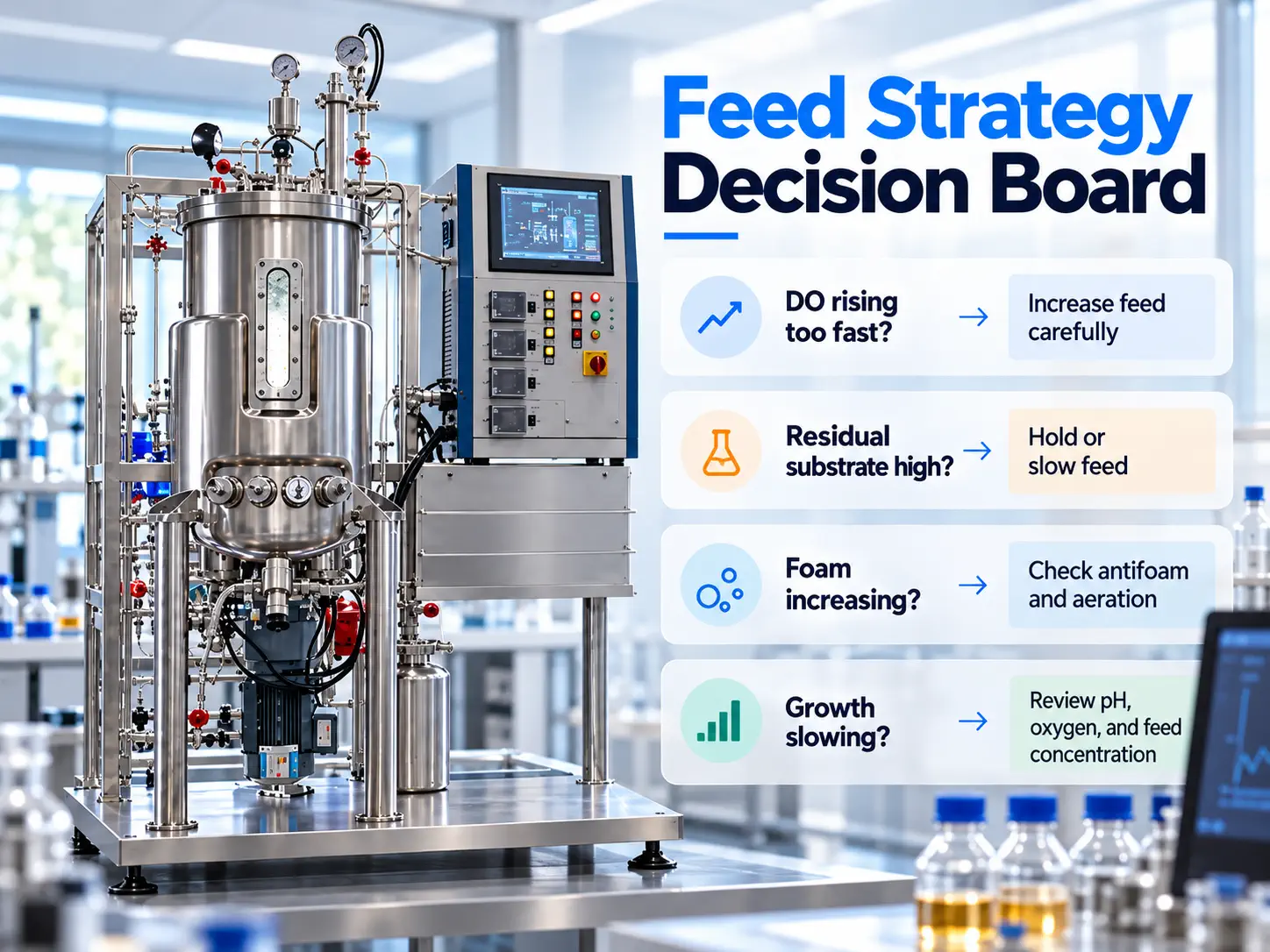
Figure 2. A simplified decision board for engineering discussion, not an automatic control recipe. Investigate the process and verify independent measurements before changing feed settings.
DO drops faster than expected
Check feed delivery against the schedule, the gas and agitation response, the probe condition and the culture phase. A feed-related increase in oxygen uptake is one possibility; transfer-side or sensor-side issues are others. Record timing before diagnosing root cause.
Foam persists despite dosing
Verify the antifoam line and dosing history, then examine sparging, headspace, medium and the current fermentation stage. Do not assume a larger antifoam dose is always appropriate; review its validated range and downstream implications.
pH correction rises following nutrient addition
Review the feed chemistry, microbial production of acids or bases, sensor calibration and where the feed enters the mixing field. Correcting pH without investigating the feed response can mask the underlying condition.
Actual feed volume disagrees with the controller display
Check whether the pump was calibrated with a fluid and tubing condition representative of actual operation. Look for tubing wear, line restrictions, leaks, empty vessels, siphoning or tracking errors. Confirm by an independent gravimetric or suitably validated method when possible.
From glass development runs to stainless steel fermentation vessels
The move from a benchtop glass bioreactor to a larger stainless steel fermenter creates more than a volume change. The placement of feed addition relative to the mixing field, line length, sterility of connections, pump operating range, feed vessel handling, measurement lag and gas-liquid transfer can all change. A feed schedule should therefore be reviewed against new mixing and transfer conditions, not scaled only by multiplying liters.
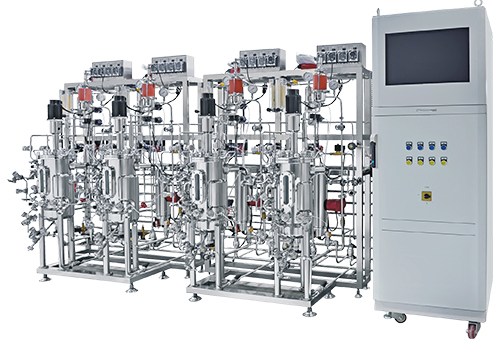
The OLLITAL stainless steel bioreactor fermentor product page presents a system with temperature, DO, agitation and feeding-related controls. A buyer evaluating a scale transition should ask OLLITAL to confirm the final hardware architecture, available pump channels, port layout, sensor types, controller functions and cleaning/sterilization requirements for the requested vessel. Web-page feature examples are not a substitute for an agreed configuration drawing.
A useful scale-transfer package includes the original feed profile and actual batch record, feed concentration, working volume, time-aligned DO/pH trends, agitation/aeration history, antifoam usage, lab assay results, process deviations and the target operating window. This evidence gives a supplier and process team a basis for selecting hardware without promising that a new vessel will reproduce results automatically.
An engineer-ready discussion with OLLITAL
For a productive discussion, describe the organism and process goal, normal operating volume, substrate feed formulation, anticipated feeding mode, critical DO/pH/temperature limits, foam behavior, sterility constraints and available utilities. State whether the planned use is microbial fermentation or another culture type: their oxygen, shear and feeding needs may differ significantly.
Ask which pumps are available on the intended model, how actual delivery is verified, whether feed profiles can be programmed or recorded, how DO and agitation control interact, how foam is detected, and what data can be exported. Confirm each item on the selected model and quotation rather than assuming that every listed feature is standard.
For equipment examples, review the customizable glassware bioreactor, the laboratory glass fermentation tank, and the stainless steel fermentation system. Each page illustrates a different configuration context; the appropriate choice depends on the actual process.
The decision that matters most
The most effective fed-batch strategy is not necessarily the most complicated one. A simple, validated feed schedule with meaningful monitoring can be preferable to an ambitious feedback loop built on unreliable signals. The process team should be able to explain why the feed changes, what biological or transfer constraint it addresses, how it will detect a wrong assumption, and what action is allowed when the run deviates.
When you are ready to translate those process requirements into a specific bioreactor configuration, send OLLITAL your working volume, feed profile, gas and agitation needs, foam-control plan and control-data expectations through Contact OLLITAL. We can use that information to review a more suitable system configuration rather than relying on a generic equipment request.