Perfusion Bioreactor Process Control: Cell Retention, Bleed and Viability
2026-10-23 16:06:08A practical guide to steady culture volume, membrane performance, cell-density control and equipment RFQ decisions.
The real challenge is stability, not simply replacing spent medium
A perfusion process adds fresh medium while removing an approximately corresponding liquid stream, often with a cell-retention device to keep most viable cells inside the culture. It can support high cell concentrations, but its apparent simplicity hides several coupled controls. Medium flow influences nutrient and metabolite levels; cell bleed influences biomass; a membrane or alternative retention device influences product harvest, cell loss, pressure and maintenance. Changing any one may affect the others.
At OLLITAL, we recommend designing the bioreactor and its external perfusion circuit as one process system. A vessel with excellent pH, dissolved oxygen (DO) and temperature control is not necessarily an operationally complete perfusion system. The buyer must also define pumps, sterile connections, retention method, vessel-volume strategy, sampling, alarms and evidence for the intended cell line or culture. Those items should be confirmed in the specific quotation, not inferred from a general product name.
1 | Define all liquid outlets before choosing the controller
A typical perfusion setup has fresh-medium input, cell-lean permeate or harvest output, and a cell-containing bleed used to manage biomass. Sampling, antifoam or base additions may also change the liquid balance. These streams have different functions and cannot be treated as interchangeable. A flow meter on a harvest line does not describe how much viable biomass leaves through the bleed line.
Steady volume condition. For a constant vessel volume, total liquid entering the chosen balance boundary approximately equals liquid leaving over the same interval. Include all additions, samples and bleed when reconciling the flows. Net mass changes, evaporation and density effects may also matter when high precision is needed.
A level signal or vessel weighing system can reveal drift between nominal pump settings and actual delivery. Small pump calibration errors can accumulate during a multiday campaign. For this reason, define which quantity is the control reference: balance-based vessel weight, validated level measurement, or a verified volumetric-flow strategy. Each option has different constraints when foam, tubing wear and gas hold-up change.
2 | Perfusion rate and cell bleed answer different questions
A feed rate expressed only in vessel volumes per day can be useful for equipment comparison, but it does not normalize medium supply to cell demand. In cell culture, teams may track a cell-specific perfusion rate, often expressed as daily fresh-medium volume divided by viable cell number. It is an operating descriptor, not a universal recommended setpoint; the appropriate value depends on cellular metabolism, medium formulation, process stage and target performance.
Bleed is a separate control. Even with efficient retention, a culture may continue growing until oxygen delivery, mixing, nutrient transport or metabolic constraints become limiting. A controlled cell-containing bleed can help keep viable cell density in a selected range. Excess bleed wastes cells and culture liquid; insufficient bleed can allow biomass and viscosity to rise beyond the system design. Growth, death, sampling and cell escape into the permeate must be considered when interpreting density trends.
Trend together. Record viable cell density, viability, culture volume, fresh-medium flow, harvest flow, bleed flow and metabolite results on the same time base. A single acceptable viable cell count cannot establish process stability if viability is falling or the culture volume is drifting.
3 | Choose the retention mechanism before setting flux targets
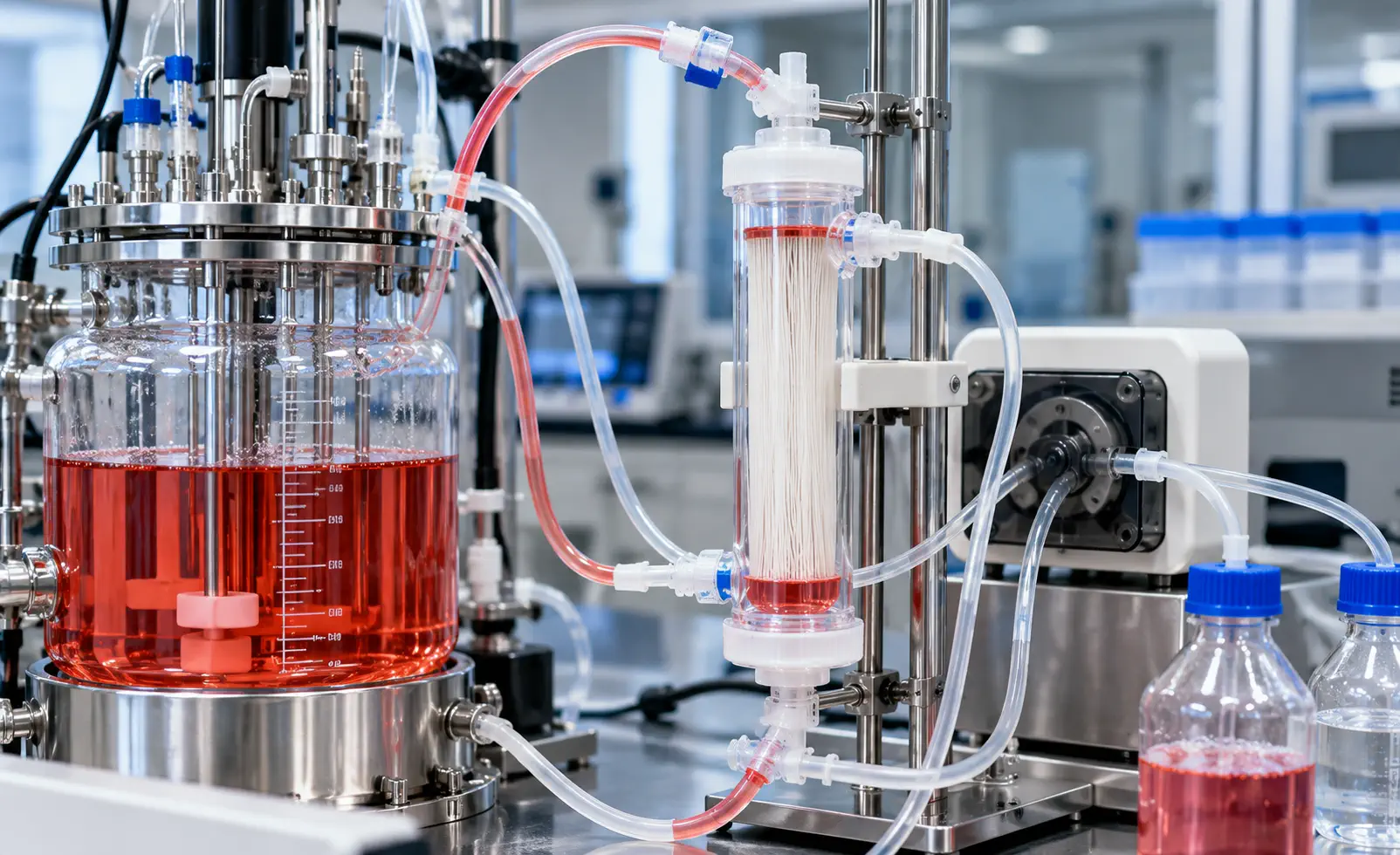
Figure 1 | Editorial close-up of a glass culture vessel, external hollow-fiber module, peristaltic pump and collection bottles. Line routing is illustrative and must not be used as an installation drawing.
Hollow-fiber filtration, other membrane devices and non-membrane cell-retention technologies do not impose the same operating constraints. For a hollow-fiber configuration, the buyer should specify whether cells travel through fiber lumens or shell-side passages, how permeate is collected, what recirculation is used and which flow direction the actual module requires. There is no safe assumption that every bioreactor marketed with a membrane-related phrase includes a ready-to-run external perfusion loop.
The membrane area and nominal pore or molecular-weight characteristics are only the starting point. Real performance also depends on culture composition, viscosity, cells and debris, pressure control, fluid shear, temperature and whether the module can be cleaned, replaced or sterilized in the intended manner. The desired cell-retention performance should be demonstrated using representative culture conditions rather than inferred from clean-water data.
4 | Understand flux and transmembrane pressure before troubleshooting
Membrane permeate flux is the permeate volume passing through a stated membrane area per unit time. For a specific module, transmembrane pressure (TMP) is calculated from appropriately located pressure measurements across the separating surface. The calculation depends on the actual module flow path, so the supplier should provide the applicable definition and sensor positions. Neither a single pressure value nor nominal pump speed tells the full story.
When an operating system is held near constant flux, an increase in TMP can indicate additional hydraulic resistance caused by deposits, cell debris, altered fluid properties or an obstruction. Air entry, tubing kinks, valve settings and instrumentation errors can also create misleading changes. A decrease in harvest flow at a fixed pressure may have similar diagnostic value, but it is not automatically proof of membrane fouling.
A rise in cell concentration measured in the permeate suggests an integrity, sealing, routing or retention-performance concern, and should be investigated separately from the rising-TMP question. A module can foul while retaining cells; conversely, a leak or bypass can cause poor retention without the usual fouling pattern. Define permissible conditions and replacement thresholds using qualified process testing and the component supplier's instructions.
| Operating observation | Possible interpretation | Useful first verification |
|---|---|---|
| Rising TMP at similar permeate flow | Increasing resistance in membrane or circuit | Pressure sensor calibration, air, tubing path and module loading |
| Harvest flow declines at similar pressure | Reduced hydraulic throughput | Pump/tubing wear, valves, feed composition and return path |
| Viable cells appear in permeate | Retention integrity or bypass concern | Sampling method, connections, gasket integrity and module limits |
| Vessel volume steadily rises | Feed-outflow imbalance | Actual pump delivery, bleed records and level/weight signal |
| Viability falls while density remains high | Nutrient or metabolic stress may be developing | Medium uptake, metabolites, oxygen and cell-density control |
5 | Avoid solving a filter problem by increasing pump stress
It can be tempting to increase circulation speed or suction when permeate output falls. That may improve flow briefly, but it can also increase mechanical stress, foam, leakage risk or irreversible deposition under some conditions. External recirculation adds another potentially sensitive environment beyond the main stirred vessel: pumps, manifolds, connectors and membrane entries may expose cells to different local stresses. An acceptable operating region must balance perfusion demand with biological outcomes and the module manufacturer's limits.
Use a staged diagnostic response: verify pressure and flow measurements, confirm vessel balance, inspect available sterile connections under approved procedures, and compare against a documented stable baseline. Escalate through the site's approved operating and quality process rather than opening a live culture circuit for an improvised check. Any sterile intervention or single-use assembly change requires an applicable contamination-control strategy.
6 | Metabolites and osmolality reveal what flow rate alone misses
High fresh-medium delivery does not guarantee an adequate growth environment. Monitor at least the variables that characterize the specific culture: substrate trends such as glucose or another main carbon source, byproducts such as lactate or ammonium where relevant, osmolality, pH, dissolved oxygen, dissolved carbon dioxide if measured, cell density and viability. The value of each variable depends on the process. Some cell systems have important limits not apparent from vessel-average pH and DO.
When metabolic demand rises, adding medium may dilute inhibitors but also alter osmotic balance and drive up spent-medium consumption. An effective investigation therefore asks whether the abnormality is driven by cell growth, changing uptake, retention performance or a shift in actual delivered flow. Trend results against viable cell density and elapsed culture time; avoid claiming a single glucose, lactate or viability threshold works for every cell line.
7 | Sampling must protect both sterility and comparability
A perfusion experiment can appear to drift simply because sample locations and analytical methods changed. Vessel samples describe the retained culture population. Cell-lean harvest samples describe the permeate stream. Bleed samples describe cells intentionally removed from the system. These are not interchangeable biological materials, and sampling should be linked to the process location, flow history and sample handling time.
Develop an appropriate aseptic sampling procedure and document whether samples were taken before or after a feed event, flow adjustment or membrane change. If an analyzer is used for viability, evaluate sample dilution, cell aggregation and holding time. When validating retention, compare appropriately matched vessel and permeate samples and confirm the analytical method is sensitive enough for the expected cell levels.
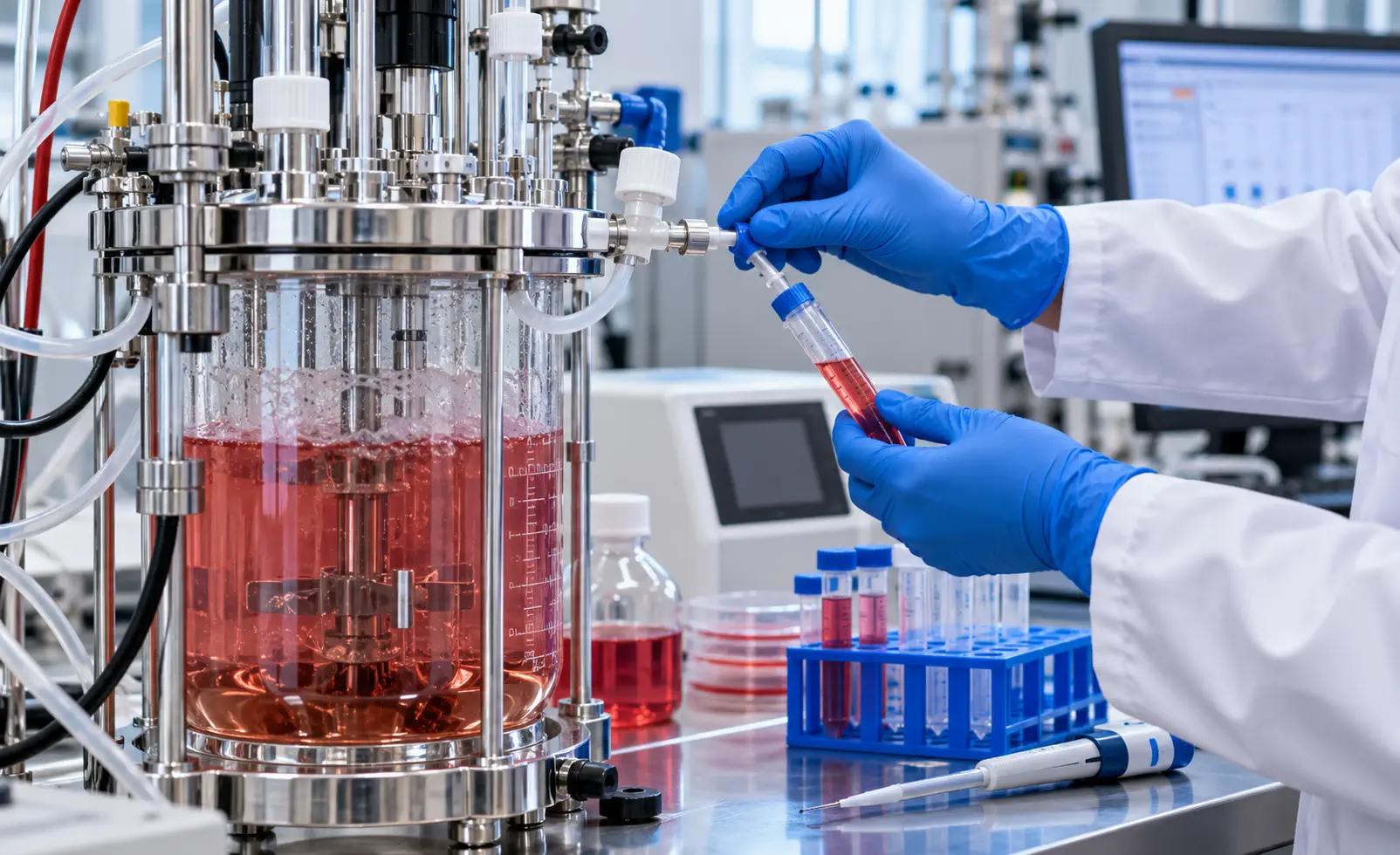
Figure 2 | Editorial depiction of aseptic culture sampling for viability and process monitoring. No readings or sterility outcomes are implied by this illustration.
8 | Scale up the external loop, not only the vessel
Scaling a perfusion process is not just changing the working volume on a purchase order. The larger system may need different membrane area, external recirculation rate, head pressure, tubing dimensions, pump selection and temperature management. Residence time outside the vessel may change, as may the pressure distribution across the retention device. A bench demonstration may not predict long campaigns with higher cell load, different gas handling or a new tubing path.
For a scale-up plan, establish the process constraints first: acceptable viable-cell density and viability, working-volume control accuracy, perfusion demand, membrane-life expectations, contamination strategy and hold-up volume. Compare the proposed design against these needs using matched biological tests. A transfer principle based only on identical membrane flux or vessel-volume exchange rate may overlook altered shear or mixing conditions.
9 | What the OLLITAL product pages show, and what to confirm
OLLITAL lists glass and stainless-steel bioreactor families with temperature, pH, dissolved-oxygen and agitation controls. A glass-bioreactor page is titled “Glass Jacketed Hollow Fiber Membrane Bioreactor,” and a separate stainless-steel listing carries a perfusion-related product name. These pages confirm relevant vessel families, but the published specifications do not establish that an installed hollow-fiber cartridge, sterile harvest pump, cell-bleed controller, defined TMP monitoring and complete tubing set are all supplied together with every quoted model.
For procurement, request a confirmed process and instrumentation diagram and a bill of supply for the exact configuration. Identify the retention module brand and format if proposed, the sterilization boundary, whether the tubing and sensors are single-use or reusable, and who owns qualification of flux and cell retention. If supplier data are generic, ask for a clear separation between standard vessel functions, optional components and customer-provided utilities or disposables.
10 | Build the RFQ around operating evidence
| RFQ item | Minimum clarification needed |
|---|---|
| Vessel and culture | Working volume, organism or cell line, growth mode and control setpoints |
| Retention method | Module and flow-path specification, membrane area, material, replacement approach |
| Pumps and lines | Measured feed, harvest, bleed and recirculation duties; tubing and sensor materials |
| Monitoring and alarms | Vessel level/weight, pressures, flows, pH, DO, temperature and data access |
| Performance criteria | Viable cell density/viability targets, cell escape check, duration and allowable pressure drift |
| Cleaning / sterility | Sterile assemblies, approved changeover steps, sampling strategy and scope of supply |
Agree on what a commissioning trial can realistically prove. A water-based hydraulic test checks parts of the flow path, but cannot validate cell retention, metabolic stability or biological compatibility. A cell-culture run requires representative medium and inoculum, controlled sampling, an agreed operating window and a documented definition of failure. If the process must continue for many days, a brief acceptance test alone is not equivalent to campaign reliability.
The decision: specify the balance of cells, medium and hydraulic capacity
A successful perfusion system maintains productive cells inside the intended culture boundary while removing spent medium and product through a controlled path. That requires a meaningful cell-density strategy, a defensible retention device, reliable fluid balance and a monitoring plan that distinguishes biology from hydraulic faults. Neither a headline “perfusion-ready” label nor a large pump rating proves these conditions are met.
At OLLITAL, we recommend sharing a process description and clearly defined intended operating ranges before finalizing the bioreactor arrangement. Our engineering discussion can then address the vessel family, optional retention assembly, flow-control interfaces, sampling and commissioning questions without assuming that every accessory is standard equipment.
Explore the OLT-100-M1 glass bioreactor product page, the OLT-500 stainless-steel bioreactor listing and the bioreactor equipment category for published family information; confirm all perfusion hardware in the quotation.
Need to define a perfusion loop for your process? Share your working volume, retention concept, viable cell density range and expected medium-exchange duty. Contact OLLITAL to discuss an appropriate engineering scope.